
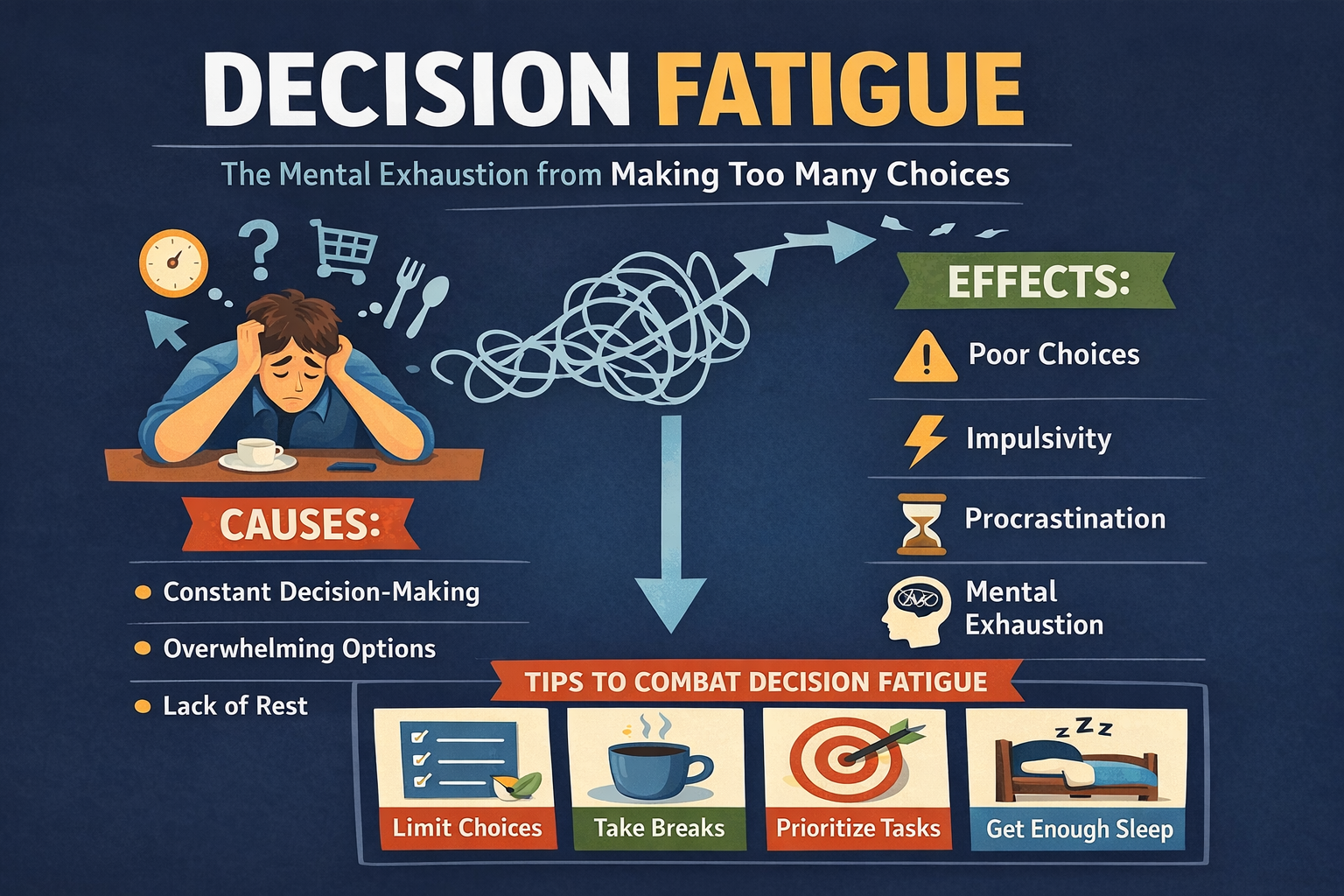
When Success Starts to Feel Mentally Heavy
Entrepreneurs are celebrated for their ability to make fast, high-stakes decisions. From strategic pivots to daily operational choices, the entrepreneurial role is defined by constant cognitive demand. But beneath the surface of productivity and performance lies a hidden biological reality:
Your brain is not designed to make unlimited decisions.
At a certain point, even the most driven founders experience what feels like fog, hesitation, or poor judgment. This is not a failure of discipline—it is decision fatigue, a biologically rooted phenomenon that directly impacts cognitive performance, emotional regulation, and ultimately, business outcomes.
Understanding the biology behind decision fatigue allows entrepreneurs to move from self-blame to strategy—transforming how you manage energy, clarity, and performance.
What Is Decision Fatigue?
Decision fatigue refers to the decline in the quality of decisions after a prolonged period of decision-making. As the brain becomes depleted, it begins to:
Avoid decisions altogether
Default to easier or impulsive choices
Experience slower processing and reduced clarity
Become more emotionally reactive
For entrepreneurs, this can show up as:
Procrastinating on critical business moves
Saying “yes” to misaligned opportunities
Overthinking simple decisions
Feeling mentally exhausted by mid-day
But to truly understand decision fatigue, we need to go deeper—into the biology of the brain.
The Brain’s Energy System: Why Decisions Are Metabolically Expensive
Your brain represents only about 2% of your body weight, yet it consumes roughly 20% of your total energy. This energy is primarily derived from glucose and oxygen.
Every decision you make requires activation of the prefrontal cortex—the part of the brain responsible for:
Planning
Reasoning
Impulse control
Strategic thinking
This region is highly energy-demanding. Each decision depletes available metabolic resources, particularly:
Glucose (fuel for neurons)
Neurotransmitters (chemical messengers)
Oxygen (for cellular energy production)
As these resources decline, the brain shifts into a conservation mode—reducing effort and favoring shortcuts.
The Role of Glucose and Blood Glucose Stability
One of the most critical biological drivers of decision fatigue is blood glucose regulation.
When blood glucose is stable, the brain functions efficiently. But when it fluctuates—due to poor nutrition, stress, or metabolic dysfunction—the brain experiences:
Reduced cognitive clarity
Slower processing speed
Increased irritability
Impaired decision-making
Entrepreneurs often skip meals, rely on caffeine, or consume high-sugar foods, leading to spikes and crashes in blood glucose. These fluctuations directly impair the brain’s ability to sustain high-quality decisions throughout the day.
Over time, repeated instability can contribute to insulin resistance, further compromising brain energy utilization.
Neurotransmitters: The Chemistry of Clarity and Focus
Decision-making is not just about energy—it’s also about neurotransmitter balance.
Key neurotransmitters involved in decision-making include:
Dopamine → motivation, reward, goal-directed behavior
Serotonin → mood stability, emotional regulation
Acetylcholine → attention, learning, memory
GABA → calming the brain, reducing overstimulation
As the day progresses, neurotransmitter levels can become depleted, especially under chronic stress. This leads to:
Reduced motivation
Difficulty focusing
Increased anxiety or overwhelm
Poor judgment
For entrepreneurs, this can feel like a sudden drop in drive or clarity—even when the workload hasn’t changed.
Cortisol and the Stress–Decision Connection
Entrepreneurship is inherently stressful. While short bursts of stress can enhance performance, chronic stress leads to elevated levels of cortisol, the body’s primary stress hormone.
When cortisol remains elevated:
Blood glucose becomes unstable
The brain shifts away from the prefrontal cortex
The amygdala (emotional center) becomes more dominant
This shift results in:
Reactive decision-making
Increased fear-based thinking
Reduced strategic clarity
Impaired risk assessment
In other words, chronic stress biologically pushes entrepreneurs toward survival-based decisions instead of growth-oriented decisions.
The Prefrontal Cortex vs. The Survival Brain
At the core of decision fatigue is a tug-of-war between two brain systems:
1. The Prefrontal Cortex (Executive Brain)
Logical
Strategic
Future-oriented
Energy-intensive
2. The Limbic System (Survival Brain)
Emotional
Reactive
Habit-driven
Energy-efficient
As energy declines, the brain defaults to the limbic system, because it requires less effort.
This is why decision fatigue often leads to:
Impulsive spending or business decisions
Avoidance of complex tasks
Preference for familiar or “safe” choices
Emotional reactions instead of rational analysis
Mitochondria: The Hidden Drivers of Mental Energy
At a cellular level, decision fatigue is deeply connected to mitochondrial function.
Mitochondria are responsible for producing ATP (energy) within your cells—including brain cells. When mitochondrial function is compromised due to:
Chronic stress
Inflammation
Poor nutrition
Lack of sleep
The brain simply cannot produce enough energy to sustain high-level decision-making.
This leads to:
Brain fog
Mental fatigue
Reduced cognitive endurance
Slower thinking
For entrepreneurs, business owners, founders, executives and solopreneurs, mitochondrial health is not just a wellness concern—it is a performance determinant.
Inflammation and Cognitive Decline
Chronic low-grade inflammation—common in high-stress, high-performance individuals—has a direct impact on brain function.
Inflammation affects:
Neurotransmitter production
Blood flow to the brain
Synaptic communication
This results in:
Reduced mental clarity
Difficulty concentrating
Increased fatigue
Mood instability
Inflammation essentially creates a “noisy” brain environment, making clear, strategic decision-making much harder.
Sleep Deprivation and Decision Impairment
Sleep is one of the most overlooked drivers of decision fatigue.
During sleep, the brain:
Clears metabolic waste
Restores neurotransmitter balance
Replenishes energy stores
Consolidates memory
Lack of sleep impairs the prefrontal cortex and increases activity in the amygdala, leading to:
Poor judgment
Increased emotional reactivity
Reduced attention span
Lower problem-solving ability
Entrepreneurs, founders, executives, business owners and solopreneurs who sacrifice sleep for productivity often pay the price in reduced decision quality.
The Cognitive Load of Entrepreneurship
Unlike traditional roles, entrepreneurs face unstructured, continuous decision-making:
Strategic decisions
Financial decisions
Hiring decisions
Marketing decisions
Operational decisions
This constant cognitive load accelerates decision fatigue because:
There are fewer automated processes
The stakes are higher
The ambiguity is greater
Without systems to reduce decision load, the brain becomes overwhelmed, leading to diminished performance.
The Business Cost of Decision Fatigue
Decision fatigue is not just a personal issue—it has measurable business consequences:
Slower execution
Missed opportunities
Poor hiring choices
Inefficient use of resources
Reduced innovation
At scale, decision fatigue becomes a hidden revenue leak, silently limiting growth and performance.
Biological Strategies to Reduce Decision Fatigue
Understanding the biology allows for targeted interventions. High-performing entrepreneurs can protect and enhance decision-making capacity by optimizing their physiology.
1. Stabilize Blood GLUCOSE
Eat balanced meals with protein, healthy fats, and fiber
Avoid excessive sugar and refined carbohydrates
Don’t skip meals
2. Optimize Brain Fuel
Prioritize nutrient-dense foods
Support mitochondrial health with key micronutrients
Stay hydrated
3. Manage Stress Physiology
Incorporate daily stress regulation practices (breathing, movement, recovery)
Avoid chronic overactivation of the stress response
4. Protect Sleep
Aim for consistent, high-quality sleep
Establish a wind-down routine
Limit late-night stimulation
5. Reduce Decision Load
Automate routine decisions
Create systems and standard operating procedures
Batch similar decisions together (Cluster Decisions Process™)
6. Align Decisions with Peak Energy
Schedule high-stakes decisions during peak cognitive hours
Avoid making important decisions when fatigued
The Future of Entrepreneurial Performance: Biology-Driven Leadership
The next evolution of entrepreneurship is not just about strategy—it’s about biological optimization.
Leaders who understand and optimize their internal systems will have a distinct advantage:
Faster, clearer decision-making
Greater resilience under pressure
Sustained energy throughout the day
Improved business outcomes
This is the foundation of what I call Metabolic Leadership™—where biology becomes a strategic asset.
Your Brain Is Your Greatest Business Asset
Decision fatigue is not a weakness—it is a biological signal.
It is your body telling you that the systems supporting your performance need attention.
Entrepreneurs who ignore this signal often experience burnout, stagnation, or declining performance. But those who understand it can transform their capacity to lead, decide, and grow.
Because at the highest level of business:
Your success is not just determined by your strategy—
it is determined by the biology that powers it.